iOS 19 Likely to Sync Captive Wi-Fi Data Between Devices

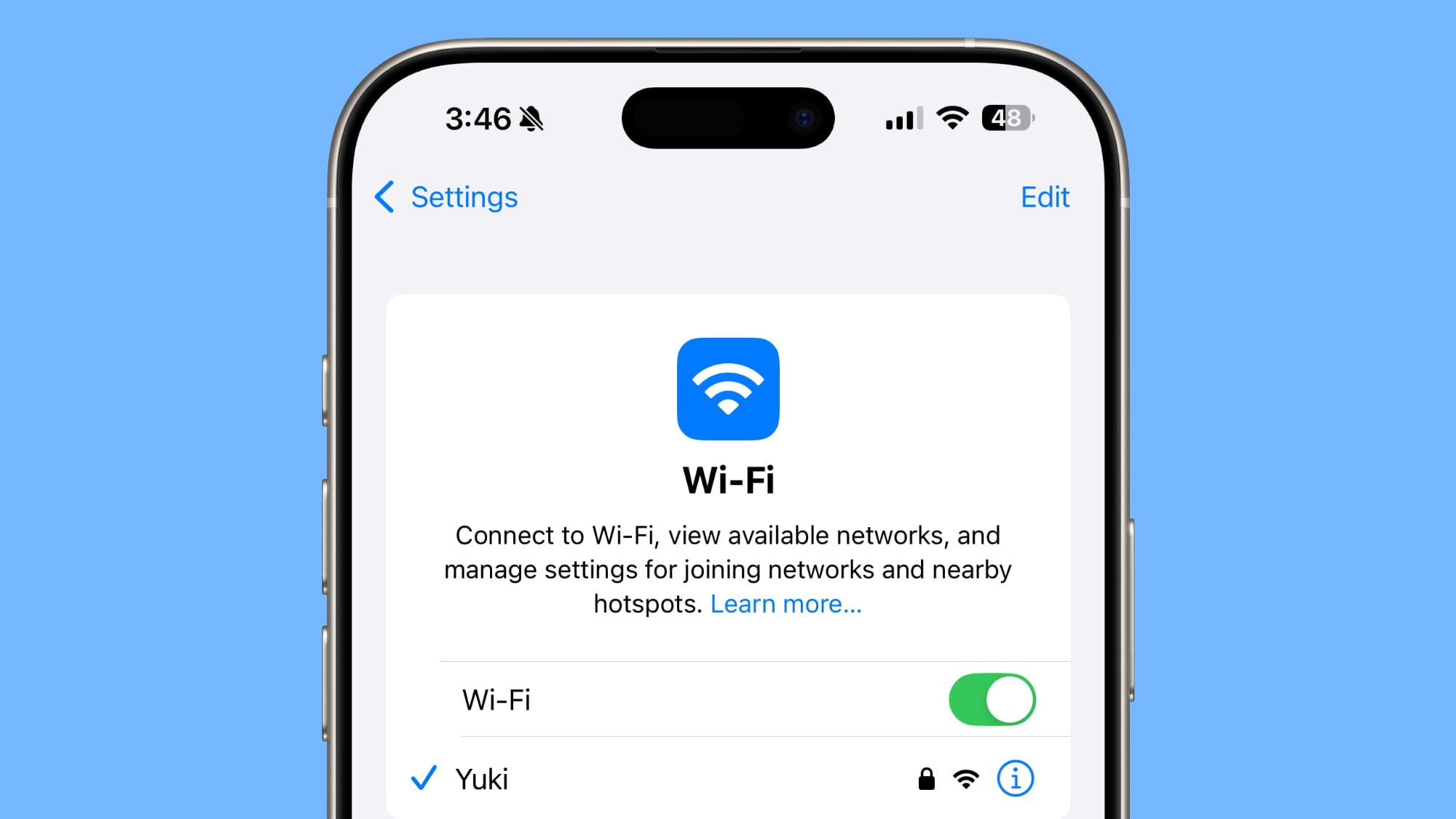
Apple is developing a new feature that will synchronize captive Wi-Fi portal login information across devices, according to Bloomberg‘s Mark Gurman.


The system will allow users to enter login details for captive Wi-Fi networks – commonly found in hotels, airports, and coffee shops – just once, then automatically sync that information across their iPhone, iPad, and Mac devices.

“When you go to a new hotel, office building or gym, you’re often asked to fill out a web form on all your devices before you can access the internet,” Gurman reports. “This new feature will let you enter that information on one device and have it synched to your other products.”

This time-saving addition should eliminate the frustration of repeatedly logging into the same network portal across multiple Apple devices.

Apple is reportedly readying the feature in time for WWDC 2025, suggesting it will likely arrive with iOS 19, iPadOS 19, and macOS 16.

This article, "iOS 19 Likely to Sync Captive Wi-Fi Data Between Devices" first appeared on MacRumors.com

Discuss this article in our forums

Read More

AirPods and Apple Watch Models to Get Tiny AI Cameras in 2027

Apple plans to add tiny cameras to AirPods and Apple Watch models in 2027 that will embed Apple Intelligence in the devices, according to Bloomberg‘s Mark Gurman.


The cameras are expected to scan the environment and describe objects, similar to the Visual Intelligence feature on newer iPhones. Apple is also working on smart glasses that include cameras, microphones, and integrated AI, much like the Ray-Bans from Meta. The glasses are also expected by 2027, according to Gurman.

Apple is developing a new chip for the smart glasses, and it is said to be based on chips that are used in the Apple Watch, so there’s likely to be AI feature crossover across the devices.

The cameras could be infrared sensors. In a June 2024 blog post, Apple supply chain analyst Ming-Chi Kuo said Apple planned to mass produce new AirPods with infrared cameras by 2026. The infrared cameras could potentially enable “in-air gesture control” as well, allowing for device interaction with hand movements, according to Kuo.

Given Kuo’s 2026 mass production timeframe, we could potentially see the new AirPods with infrared cameras launch in 2026 or 2027.

Related Forums: AirPods, Apple Watch

This article, "AirPods and Apple Watch Models to Get Tiny AI Cameras in 2027" first appeared on MacRumors.com

Discuss this article in our forums

Read More

Honor Magic V5 to come soon with huge battery increase

Honor launched the Magic V3 with a minor battery increase over its predecessor, but its successor will go even further. Honor Magic V5 (Magic V4 expected to be skipped) will have a 6,000 mAh cell, according to listings on MIIT and 3C. The foldable battery will have two cells — one of 2,070 mAh capacity and the other 3,880 mAh, for a total of 5,950 mAh rated value. This is likely the minimal capacity, with the typical being over 6,000 mAh. The phone, model number MBH-AN10, will support 66W wired charging, just like the previous Magic V phones. Honor is expected to skip the…

Read More

WSJ: Apple Weighing Price Hikes for iPhone 17 Lineup Without Blaming Tariffs

Apple is considering raising prices for its upcoming iPhone 17 models set to release this fall, according to people familiar with the matter cited by The Wall Street Journal.



The company reportedly aims to pair the potential price hikes with new features and design changes to justify the increased cost to consumers, rather than attributing them to U.S. tariffs on goods from China.

The U.S. and China recently agreed to suspend most tariffs imposed during their trade dispute, but a 20% tariff implemented by President Trump on Chinese goods remains in place and covers smartphones.

The WSJ report notes that Apple is particularly concerned about avoiding any appearance that price increases are directly related to tariffs. From the report:

The people familiar with the supply chain said Apple would have trouble making up for China tariff costs solely by seeking further savings from its suppliers, meaning a hit to its profit margin was likely unless it could raise prices.

At the same time, company executives are wary of blaming increases on tariffs. When a news report in April said Amazon might show the impact of tariffs to its shoppers, the White House called it a hostile act and Amazon quickly said the idea “was never approved and is not going to happen.”

These circumstances have led Apple to look at what supply-chain insiders described as the least-bad choice: raising prices on the new iPhones to preserve profit and finding reasons other than tariffs to explain the move. It couldn’t be determined what new features Apple may offer to help justify price increases.

Amid growing pressure over U.S.-China trade tensions, Apple has built up inventory and shifted manufacturing for the U.S. market to India. Apple CEO Tim Cook stated earlier this month that a majority of iPhones shipped to the U.S. in the April-June quarter would come from India.

However, Chinese factories will continue to handle most production for Apple’s high-end Pro and Pro Max models, as India’s infrastructure and technical capabilities aren’t yet sufficient to support mass production at China’s scale.

The upcoming iPhone lineup, expected to be called iPhone 17, is expected to include an all-new ultra-thin iPhone 17 Air, which replaces the Plus model in Apple’s lineup. Current iPhone models range from the base iPhone 16 starting at $799 to the iPhone 16 Pro Max at $1,199.

This article, "WSJ: Apple Weighing Price Hikes for iPhone 17 Lineup Without Blaming Tariffs" first appeared on MacRumors.com

Discuss this article in our forums

Read More